



Winter Pine Beetle Identification

Matt Bachus
Midwestern roots planted firmly in Colorado soil—that's where my real estate approach begins...
Midwestern roots planted firmly in Colorado soil—that's where my real estate approach begins...
When the snow settles and pine beetles retreat beneath the bark, it’s easy to think the threat is over. But winter is actually your best chance to get ahead of an infestation. Jefferson County has battled periodic pine beetle outbreaks for decades, with another noticeable spike since 2023 – involving both mountain pine beetle and Ips beetle activity across the Front Range.
After more than 40 years managing beetle infestations in Evergreen, Conifer, and nearby communities, we’ve learned one thing: acting now gives you the upper hand to protect your trees and your property before the next generation emerges.
Key Takeaways
- Winter provides the most reliable beetle identification window because all life stages are contained in trees, unlike summer, when adults disperse.
- Mountain pine beetle and Ips beetle require different management strategies, so accurate identification is important in helping prevent costly mistakes.
- External signs, like pitch tubes, gallery patterns, and woodpecker damage, remain visible for ground-level inspection year-round.
- Professional confirmation ensures accurate identification and proper treatment planning before spring begins.
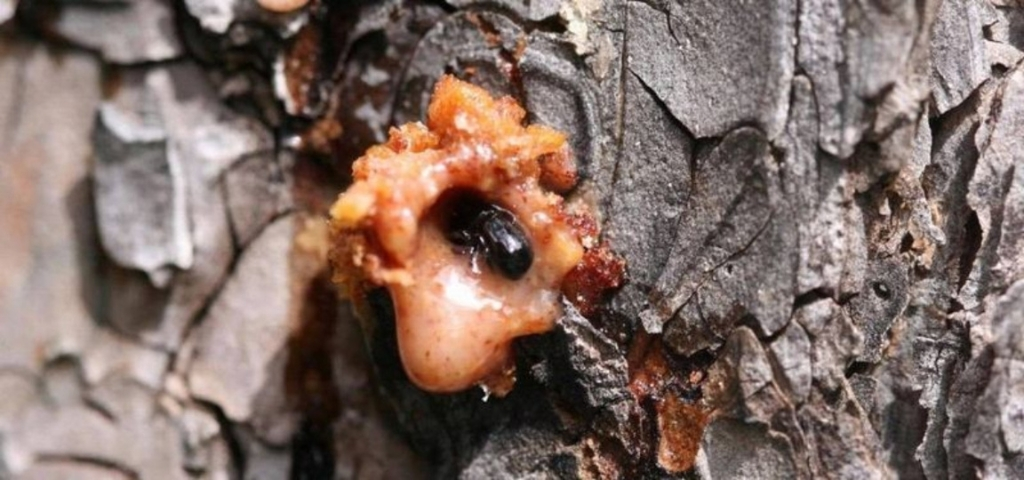
This cream to pinkish pitch tube (the tree’s resin response to a beetle attack) is one of winter’s most visible signs of mountain pine beetle on pines
Why Is Winter the Best Time to Identify Pine Beetles?
Winter offers the most reliable window for identification because both mountain pine beetle and Ips beetle are inactive beneath the bark. With beetle development paused and every life stage sealed inside the tree, it’s easier to confirm which species is present and plan management before activity resumes in spring.
Mountain pine beetles have one generation per year. Adults fly from late July through August, lay eggs, and by fall, larvae are feeding under the bark where they remain through winter and early summer. On the other hand, Ips beetles can produce multiple generations per year, but even they slow dramatically or go dormant during cold months.
How Do You Tell Mountain Pine Beetle Apart from Ips Beetle?
From the outside, both beetles can cause similar-looking damage, but the details tell the full story. Knowing which beetle you’re dealing with determines when to act, how urgently to remove trees, and what management approach to take next.
Feature Mountain Pine Beetle Ips Beetle (Engraver Beetles)
| Generations per Year | One | Two to four (depending on temperature and elevation) |
| Active Flight Period | Late July–August | April–October (can fly during warm spells) |
| Life Cycle Length | About 1 year | 6–8 weeks per generation |
| Overwintering Stage | Larvae under bark | Adults under bark or in nearby debris |
| Typical Host Trees | Ponderosa, lodgepole, and limber pine | Ponderosa and pinon pine (stressed or recently cut trees) |
| Gallery Pattern | Vertical tunnels under bark | Y- or H-shaped tunnels |
| Pitch Tube Appearance | Large, popcorn-like pitch tubes | Small or absent pitch tubes; fine boring dust instead |
| Key Management Window | Fall–early summer (before July emergence) | Late fall–early spring (remove infested wood before warm weather) |
| Behavior | Primary pest that mass-attacks healthy trees | Secondary pest that targets stressed or damaged trees |
The most reliable way to confirm the culprit is to check beneath a small section of bark. The gallery patterns, pitch tube appearance, and even the direction of attack all reveal which species is present.
Though both species tunnel beneath pine bark, their timing, behavior, and management differ completely. Misidentifying the beetle can waste time and resources – or worse, allow the next generation to spread unchecked. Winter identification gives you the advantage to plan correctly and protect nearby healthy pines before the season turns warm again.
Pro Tip: For homeowners uncertain about species identification, professional assessment prevents management mistakes. Our disease and insect management programs begin with accurate species identification because treatment strategies, timing, and urgency differ substantially between these two beetles.
Which Pine Trees Are Most at Risk in Jefferson County?
Not all pine species face the same level of pressure from pine beetles. In Jefferson County, ponderosa and lodgepole pines are the primary hosts, while other species see fewer attacks unless outbreak conditions are severe. Understanding which trees on your property are most vulnerable helps you focus inspections and prevention efforts where they matter most.
- Ponderosa Pine (Highest Risk): Ponderosa pine is the beetle’s preferred host in Jefferson County, showing roughly a 2:1 higher attack rate than lodgepole. Large, mature trees, especially those in dense or drought-stressed stands, are most at risk. Healthy trees can defend themselves with resin, but stress from overcrowding or dry conditions weakens that natural protection.
- Lodgepole Pine (Moderate to High Risk): Lodgepole pines dominate higher elevations and mixed stands with ponderosa. Mature trees over six inches in diameter are the most vulnerable, while younger ones are less frequently attacked. Past epidemics reshaped millions of lodgepole acres in Colorado, though today’s activity is concentrated in ponderosa stands.
- Limber Pine (Occasional Risk): Less common across Jefferson county, limber pine grows at higher elevations and can be attacked during widespread outbreaks. Its flexible branches and five-needle bundles help identify it. Infestations tend to be limited to stressed or isolated trees.
- Scots (Scotch) Pine (Low to Moderate Risk): A popular ornamental species in mountain communities, Scots pine can attract beetles during epidemic conditions. While not a primary host, stressed or unmaintained trees can serve as entry points for beetle spread.
- Piñon Pine (Minimal Risk from MPB): Piñon pines typically grow at lower elevations and are not attacked by mountain pine beetle. Instead, they face threats from piñon Ips beetles and other native pests that prefer warm, dry environments.
How Do You Inspect for Pine Beetles in Winter?
Inspect from ground level by checking lower trunks for cream/pink pitch tubes, reddish frass in bark crevices, and woodpecker damage with flaked bark. For species confirmation, professional arborists examine gallery patterns and larvae under the bark using safe access methods.
You can conduct an initial inspection from ground level to identify potentially infested trees, but professional confirmation ensures accurate species identification and appropriate management decisions.
What to Look for From the Ground
Start your inspection with a slow walk around your property, examining each pine tree from trunk to crown. Focus especially on ponderosa and lodgepole pines, as these are the beetles’ preferred hosts in Jefferson County. You don’t need to peel bark or climb trees – most early signs of infestation are visible from the ground.
Look for these clues:
- Pitch Tubes on the Lower Trunk: Cream to pink, popcorn-like masses on the bark (especially on the lower 15 feet) indicate mountain pine beetle entry points. Dozens or hundreds of pitch tubes suggest a successful attack; a few scattered tubes may mean the tree successfully defended itself.
- Frass in Bark Crevices: Reddish-brown sawdust (called frass) collects in bark furrows or at the tree’s base when beetles are actively boring. Fresh frass looks bright reddish-brown; older material darkens or may wash away after rain.
- Woodpecker Damage: Flaked bark and feeding holes about ½–¾ inch in diameter show where woodpeckers have extracted larvae. Heavy flaking that exposes wood often signals an active infestation – even before pitch tubes or fading needles appear.
- Fading Needles: Needle color reveals attack timing:
- Green Needles with Pitch Tubes: Current-season attack; larvae still developing.
- Yellow to Rust-Red Needles: Attack occurred 8–10 months ago; larvae will pupate in spring and emerge in summer.
- Gray Needles: Old attack; beetles have already emerged and the tree is dead but may still be structurally stable.
- Exit Holes: Small, perfectly round holes (⅛ inch across) indicate beetles have already emerged. Trees showing both gray needles and exit holes no longer contain live beetles.
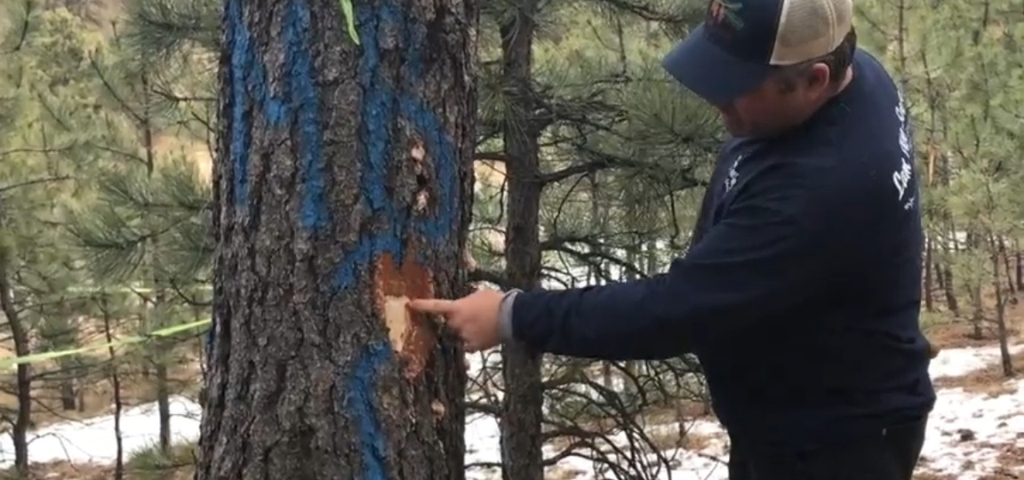
Professional bark examination reveals the blue stain fungus and gallery patterns that distinguish mountain pine beetle from Ips beetle.
Signs That Require Bark Investigation from a Certified Arborist
If you’ve spotted suspicious pitch tubes or signs of recent decline, the next step is confirming what’s happening beneath the bark. Proper identification and assessment of infestation severity often require a Certified Arborist to safely expose a small bark section and evaluate the evidence.
Certified Arborists look for three definitive signs:
- Gallery Patterns: The layout of tunnels under the bark reveals the culprit. Mountain pine beetles create a single vertical gallery with short horizontal branches, while Ips beetles form multiple galleries radiating from a central point, like spokes on a wheel.
- Larvae Presence: Finding small white grubs about ¼ inch long with dark heads confirms an active infestation. Arborists assess infestation density by counting larvae within a given area – heavier infestations may show dozens within a hand-sized section.
- Blue Stain Fungus: Grayish-blue streaks in the sapwood signal fungal infection introduced by mountain pine beetles. This fungus blocks water movement inside the tree and accelerates decline, even when beetle numbers are low.
What to Do if You Find Active Beetles
Correct species identification determines your next move because mountain pine beetle and Ips beetle require completely different management timelines.
If You Have Mountain Pine Beetle
- Remove Infested Trees Before July: Winter through spring is the ideal removal window while larvae are still contained beneath the bark. Acting early prevents the next generation from emerging and spreading.
- Dispose of Material Properly: Jefferson County prohibits transporting infested wood off-site. Trees should be chipped, debarked, or solar-treated under clear plastic (May–July) to destroy all life stages.
- Apply Preventive Sprays: Protect high-value trees with carbaryl or permethrin treatments from May through mid-July before and during adult flight.
- Thin Dense Stands: Reduce competition by selectively removing smaller or suppressed trees. Thinning increases airflow, light, and resources for stronger pines.
- Maintain Tree Vigor with Deep Watering: Water during dry spells – especially in fall – to maintain resin production, a tree’s natural defense against beetles.
If You Have Ips Beetle
- Remove Fresh Wood and Slash Immediately: Don’t stack firewood, pruning debris, or slash near living pines. Ips beetles are drawn to fresh-cut wood and can reproduce in under 30 days during warm weather.
- Keep Trees Hydrated: Ips beetles target drought-stressed trees. Consistent watering maintains vigor and resin flow, reducing the chance of attack.
- Monitor After Thinning or Pruning: Freshly cut material can attract Ips beetles. Remove debris right way and watch for top-down fading in the crown – an early sign of infestation.
- Expect Limited Spread: Ips beetles rarely cause widespread loss. They typically attack scattered, stressed, or recently damaged trees rather than entire stands.
Frequently Asked Questions About Pine Beetles
What are the earliest signs that a pine tree has been infested?
The earliest signs of pine beetle infestation are cream to pink pitch tubes on the trunk, reddish-brown frass (sawdust) in bark crevices, and flaked bark from woodpecker activity. These indicators appear before needles begin fading and are most visible on the lower 15 feet of the trunk. In Evergreen and across Jefferson County, pitch tubes typically develop in late summer after beetles bore into the bark, while woodpecker damage often becomes noticeable in winter as birds feed on larvae beneath the surface.
Can infested firewood or tree debris spread beetles to my healthy trees?
Yes, infested firewood and slash can absolutely spread beetles if not handled properly. Adult beetles can emerge from cut or stored wood in spring and fly to nearby healthy trees, starting new infestations. In the Evergreen area, Ips beetles are especially attracted to freshly cut pine wood and can complete a full life cycle in as little as 30 days during warm weather.
Do preventive sprays work on pine trees?
Yes, preventive sprays are highly effective when properly timed and applied. Treatments containing carbaryl or permethrin create a protective barrier that kills beetles on contact during their flight period. The ideal spray window in Jefferson County is May through mid-July, just before and during mountain pine beetle flight season. These sprays do not kill beetles already under the bark, so they’re best used as a preventive measure for healthy, high-value trees near infested areas.
If one tree on my property is infested, does that mean all are at risk?
Yes, if one pine is infested, nearby trees are at elevated risk, especially during active outbreak years. Mountain pine beetles release pheromones that attract more beetles to the same area, often resulting in mass attacks within a single stand. Ips beetles behave differently, typically spreading through nearby stressed or recently cut trees. That’s why early detection and removal are critical in Evergreen – infestation rarely stops with a single tree.
Protect Jefferson County’s Pines – Starting with Yours
Winter gives Jefferson County homeowners a critical window to identify beetle species and plan management before spring pupation begins. Understanding the distinction between mountain pine beetle and Ips beetle – their different attack patterns, gallery structures, and triggers – changes your entire management strategy from removal urgency to prevention focus.

Winter Pine Beetle Identification: Your Best Chance to Protect Colorado Pines
Colorado winters don’t stop pine beetles—they just hide them. Discover how to spot the...
Selling Your Home?
Get your home's value - our custom reports include accurate and up to date information.